Studying feels like work. Most of it doesn't stick.
Jon is a learning tool for adults who need to understand hard material and keep it.
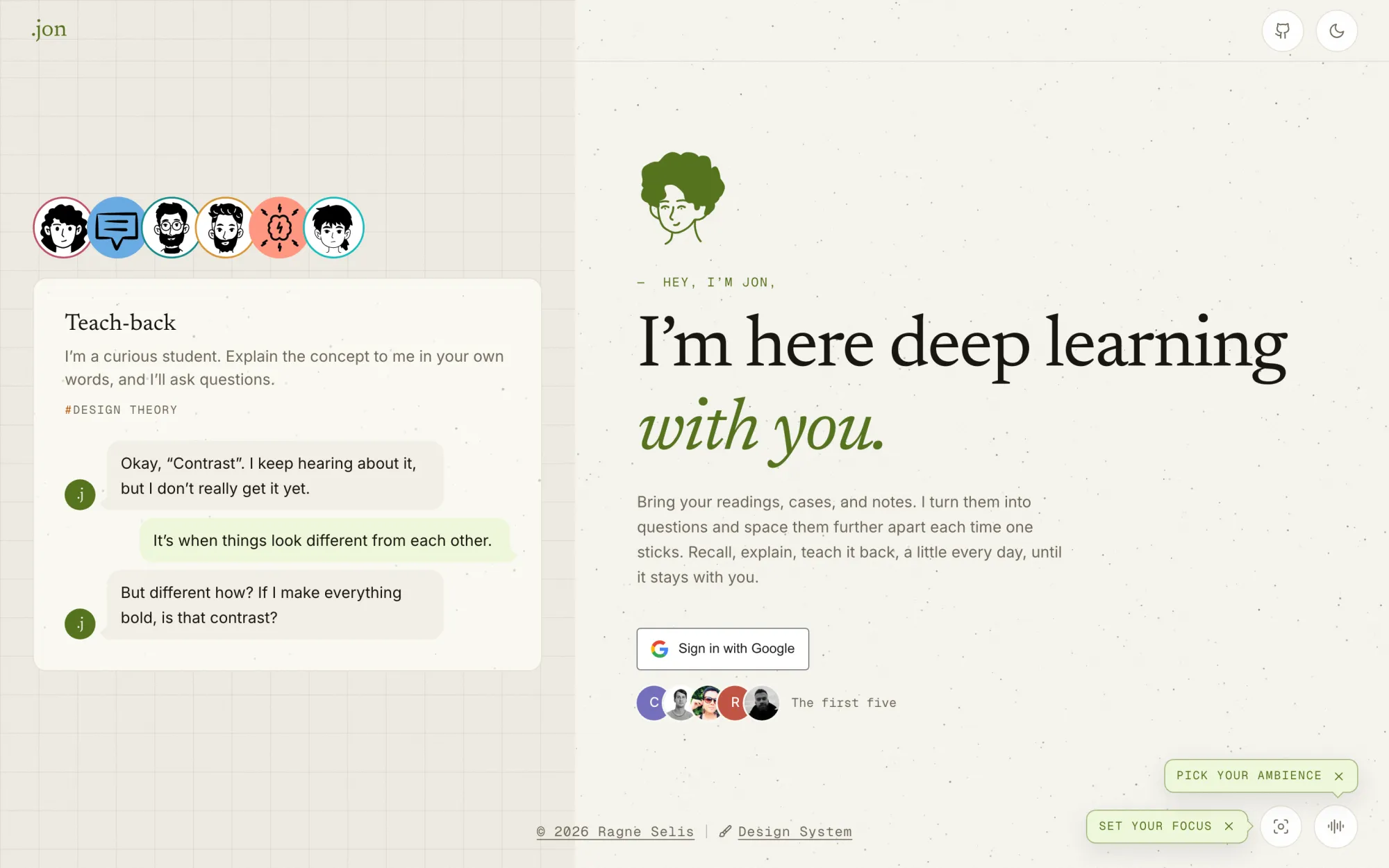
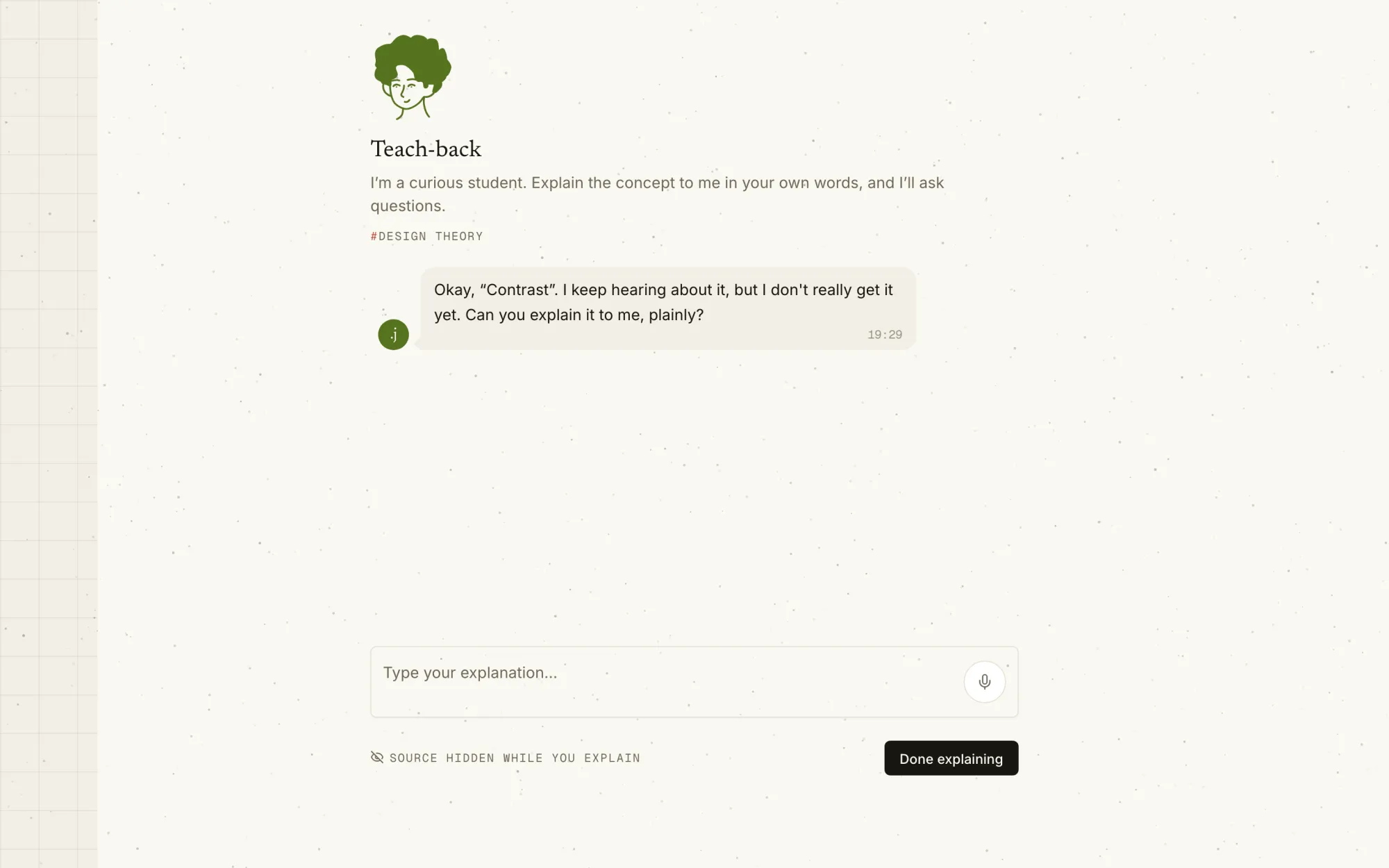
Teach-back
I’m a curious student. Explain the concept to me in your own words, and I’ll ask questions.
#Design theory
Okay, “Contrast”. I keep hearing about it, but I don’t really get it yet.
It’s when things look different from each other.
But different how? If I make everything bold, is that contrast?
.j
Okay, “Contrast”. I keep hearing about it, but I don’t really get it yet.
It’s when things look different from each other.
.j
But different how? If I make everything bold, is that contrast?
01The problem
The easiest ways to study are the weakest.
01Monday: forty pages to read.
02Highlight the important parts.
03Reread it all before the exam.
04A week later: almost nothing left.
The ones that work feel harder while you do them.
61%Remembered after a weekby testing themselves. 40% by rereading.Roediger & Karpicke, 2006
84%Reread as their study methodOnly 11% test themselves without being asked.Karpicke, Butler & Roediger, 2009
18%Test themselves to learnAbout 70% only use it to check what they know.Kornell & Bjork, 2007
02Who it's for
Built for people whose learning has to last.
It started with my own MBA. Six people now test it on their own material.
Germany
Across Europe
Move them around.
The learner
Medical resident
Age35
The job
Keep pharmacology for years, not for one exam.
When
Residency, with exams on top of shifts.
Hired instead
Rereading notes and question banks.
Done means
Can still explain it on a ward round.
Typical age
2030 to 4050
Illustrative profile. Typical ages for the role.
The learner
Law graduate before the bar
Age25
The job
Understand doctrine well enough to argue it.
When
Months of bar preparation, mostly alone.
Hired instead
Summaries and highlighted codes.
Done means
Can apply a rule to a case they have not seen.
Typical age
2023 to 2950
Illustrative profile. Typical ages for the role.
The learner
PhD researcher
Age33
The job
Turn reading into understanding they can write from.
When
Reading across a field that is new to them.
Hired instead
Highlights in PDFs and loose notes.
Done means
Can write about a concept without opening the paper.
Typical age
2027 to 4050
Illustrative profile. Typical ages for the role.
The learner
Pilot studying for the ATPL theory exams
Age25
The job
Keep it all long after the exams.
When
Many theory subjects on a fixed timeline.
Hired instead
Question banks drilled until the answers look familiar.
Done means
Knows why, not just which answer.
Typical age
2020 to 3550
Illustrative profile. Typical ages for the role.
What they come to Jon to do
Bring materialA PDF, a document or their own notes.
Explain it backFrom memory, with the source hidden.
Come back on timeEach idea returns when it is due.
03The gap
The tools exist. The method is missing.
I went through seven tools people already learn with: 24 sources, 98 claims about what each tool does. Most of them store what you know or drill what you typed in. The ones that schedule practice ask you to grade yourself.
WHAT I FOUND: Stores what you knowSO JON: Makes you use it
WHAT I FOUND: You grade yourselfSO JON: Something checks your answer
Something checks your answer
Stores what you know
Makes you use it
ChatGPT (study mode)NotebookLM
model checks, model decides
They answer, quiz and grade you. Nothing is built from your own concepts or comes back on a schedule.
Jon
Jon
You write it, something checks it, and the schedule follows.
NotionObsidianCapacitiesTana
stores, never checks
Good at keeping what you know. They don't ask you to use it.
AnkiRemNoteMochi
practice, self-graded
They bring cards back on a schedule, and you decide if you got it.
You grade yourself
Jon is built for the corner where nothing was.
04The decision
The model renders. It never decides.
Three decisions define learning. Jon gives none of them to the model.
So the rule wrote itself
What is worth learningYou+Whether you understoodCode+What you practise nextCode−The model's verdictThe model
The usual AI tutor
✕ Model decidesWhat you learn
✕ Model decidesWhether you understood
✕ Model decidesWhat comes next
The model picks the topic, grades your answer and plans what comes next.
Jon
✓ You decideWhat you learn
✓ Code decidesWhether you understood
✓ Code decidesWhat comes next
You choose what to learn. A fixed rule grades the answer and sets the next date.
If the value of a product sits in the model's output, the next better model takes it. If the decisions live in your own code, a better model only improves the inputs. It is the same thing I look for in a client's business.
05Your material
Jon never writes a concept for you.
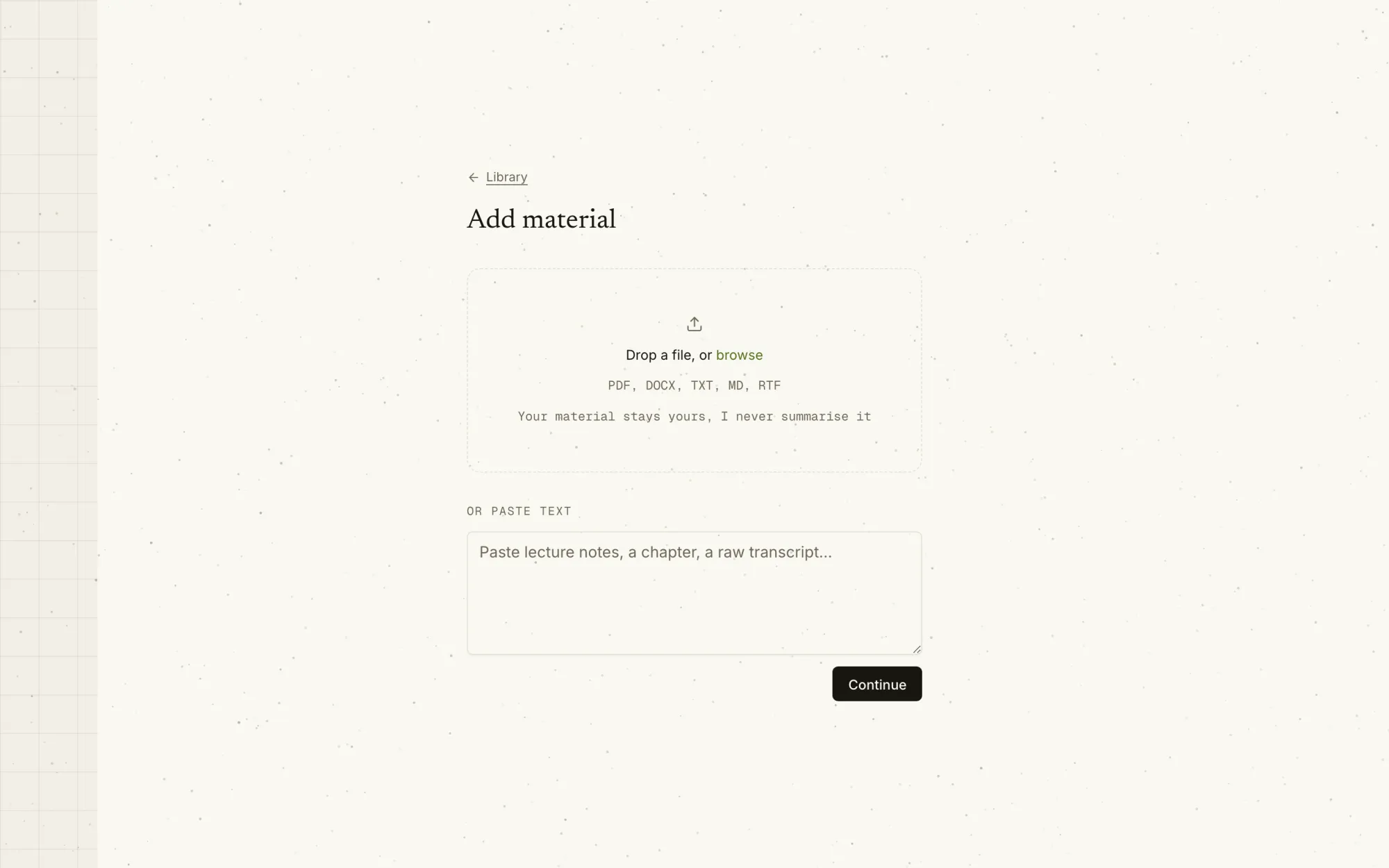
Add materialA PDF, a document or notes.
SectionsJon cuts it up and stops there.
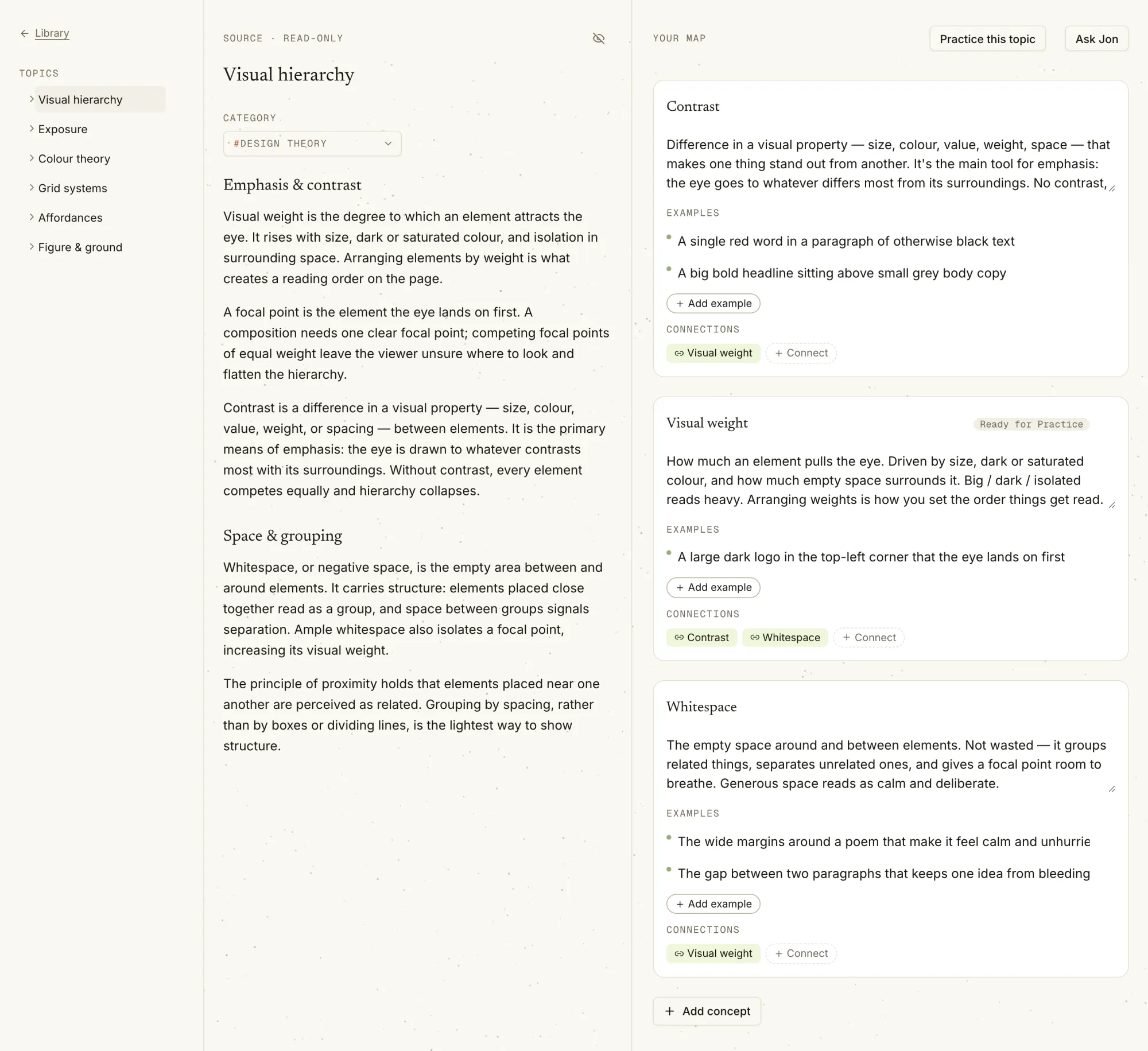
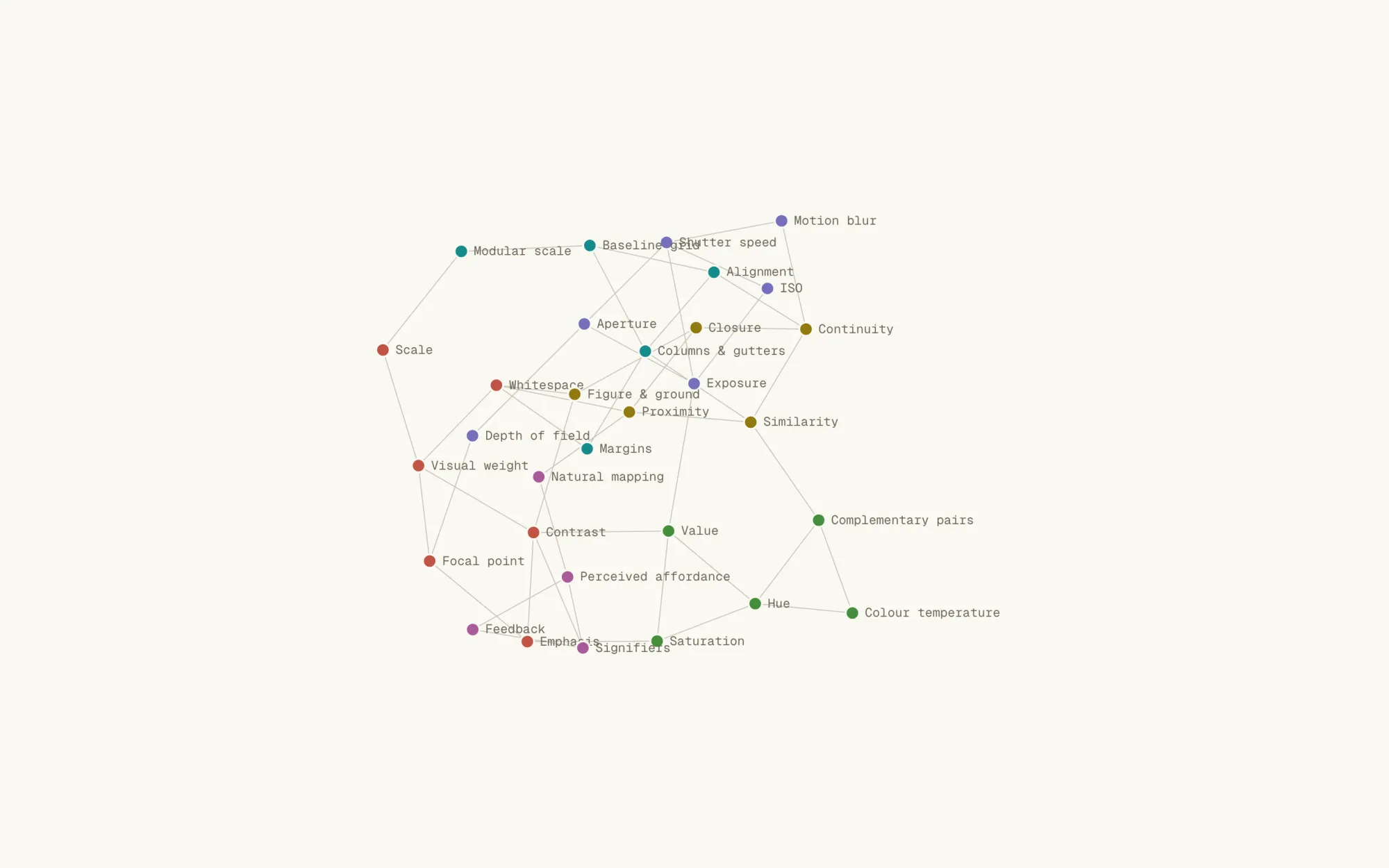
Your conceptsEach idea in your own words.Missingan idea in the source your concepts don't cover.Driftedyour concept, or its example, says something the source doesn't.Not linkedtwo ideas that belong together aren't connected.Redundanttwo concepts say the same thing.
ReadyChecked, with no open notes.
06Scoring
Further apart each time it sticks.
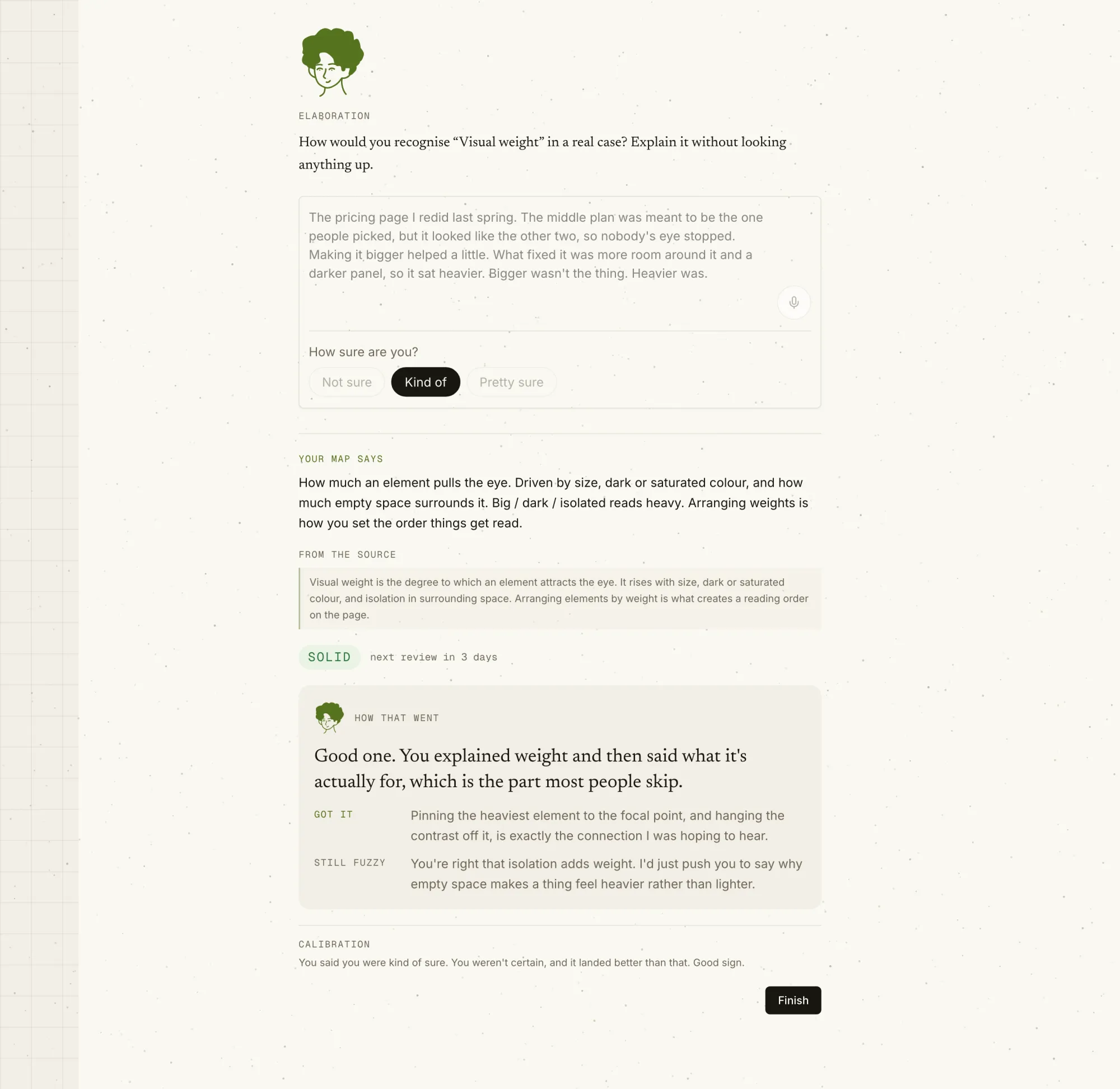
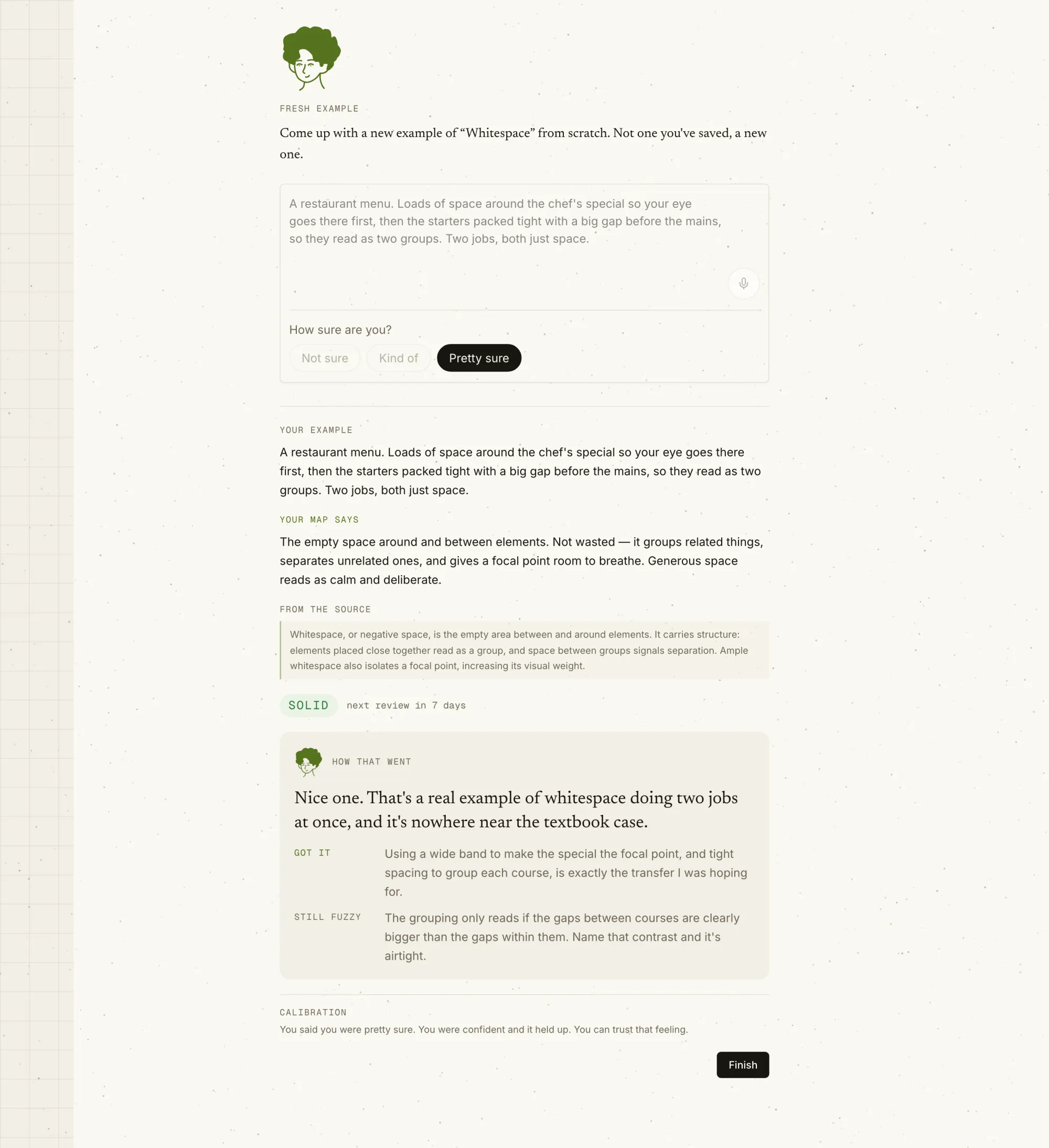
Every answer gets a verdict from a fixed rubric. The model only reads features out of your answer. Code weighs them and gives the verdict. Strong moves the idea one rung further out: 1, 3, 7, 14, then 30 days. Developing keeps the gap. Needs work comes back tomorrow and climbs again from one rung lower.
1
3
7
14
30
1371430
Score 0.81Strong
Developing0.45Strong0.75
Four rounds, each one closed a hole.
Round 1
Eleven steps to five screens
The first flow had eleven steps and a wall between studying and practising.
I cut it to five screens.
Review became a session, and the rule that the source stays hidden moved into each question.
Gaps resolved 0.4
Relationships 0.35
Term coverage 0.25
Round 2
Understanding is not vocabulary
The first scoring rule leaned on the right terms.
Version 0.2 dropped vocabulary as its backbone.
1.00.4Restatement
Round 3
The restatement hole
Repeating your own note word for word scored a perfect 1.0.
Version 0.4 caps it at 0.4.
Off-topic example0.40.4
Round 4
Examples that aren't
An example that is not actually an instance of the concept could still pass.
Version 0.5 caps it too.
07Left out
What I left out, and why.
Flip them over.
Some things are waiting rather than ruled out: a mobile app, Anki and Notion integrations, and search across your own notes.
08Shipped
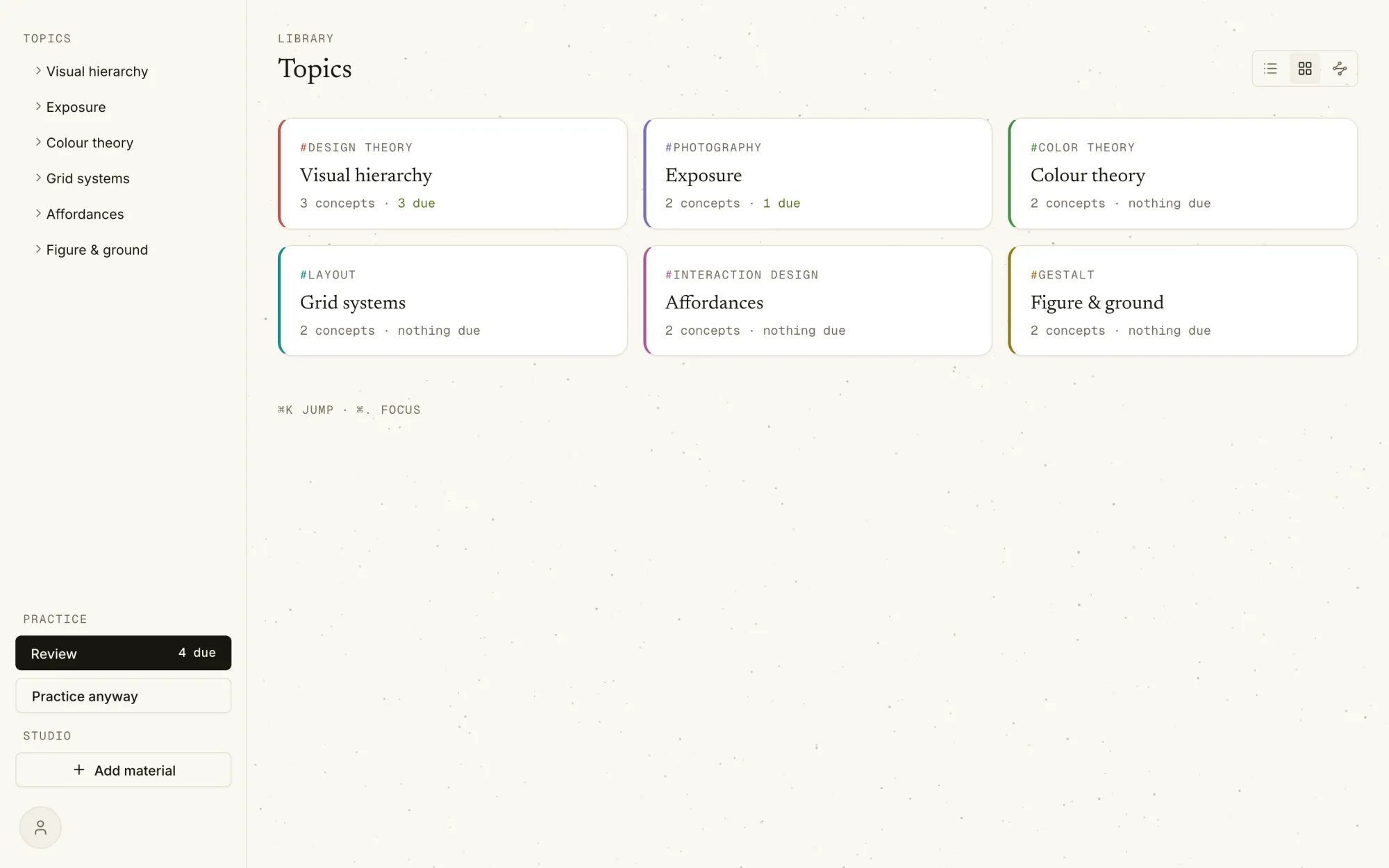
The main screens, as they run today.
Jon is built for the desktop. Flip through the screens.
6In testingpeople testing it on their own material
From the testers
Six people studying their own material
Tester 1: I want to group my concepts by topic. Right now they are one long list.
Tester 2: I need a place to actually write, like Notion, not just a box per concept.
Tester 3: Sometimes the feedback misses what I meant. It should read my answers more precisely.
Tester 4: For my PhD I need it to help me build up a whole field, not just pass a test.
Tester 5: Getting an API key was the hardest part of starting.
Tester 6: I study on the train. I need to practise on my phone.
Tester 1I want to group my concepts by topic. Right now they are one long list.
Tester 2I need a place to actually write, like Notion, not just a box per concept.
Tester 3Sometimes the feedback misses what I meant. It should read my answers more precisely.
Tester 4For my PhD I need it to help me build up a whole field, not just pass a test.
Tester 5Getting an API key was the hardest part of starting.
Tester 6I study on the train. I need to practise on my phone.
Jon is getting a cleaner brand. These are today's screens. The next version drops the beige and the grid paper for a lighter, more comic style, so your material comes first.